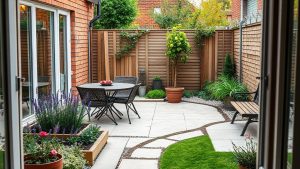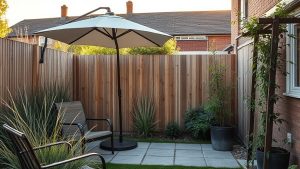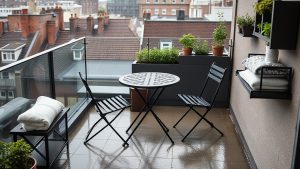
Most people who want to know how to get started with patio design begin in the wrong place. They open a photo app, save forty images of beautiful outdoor rooms, and end up more confused than when they started. Here’s the truth: patio design doesn’t begin with inspiration. It begins with three decisions. What the patio is for, how big and what shape it should be, and what surface you can actually live with. Get those right and everything else — furniture, planting, lighting, colour — falls into place almost on its own.
This is a short, practical starting point for absolute beginners. No mood boards required. Just three choices, made in order, that unlock the rest of the project.
Decide the Patio’s Main Job
A patio that tries to do everything usually does nothing well. Before you measure a single paving slab, decide what this space is mainly for. Not in a vague “relaxing and entertaining” way — in a specific, honest way.
Ask yourself what you actually did outside last summer. Did you eat meals outdoors most evenings? Then the patio’s main job is dining, and that means a table with room to pull chairs back, plus a sensible route from the kitchen. Did you mostly sit with a coffee and a book? Then the job is quiet seating, and you want a smaller, more sheltered spot, ideally catching morning sun. Did the kids use the garden as a football pitch while you watched from the back step? Then the patio is a viewing platform and a safe edge, not a stage.
Write the answer down in one sentence: “This patio is mainly for ______.” That sentence will settle more arguments later than any design magazine will.
Once the main job is clear, note one secondary use. A dining patio might also need a small spot for a barbecue. A seating patio might need a couple of pots for herbs. Two uses is plenty. Three is a warning sign that you’re trying to build a second house outdoors.
This step also decides where the patio goes. A dining area wants to be close to the back door, because nobody enjoys carrying hot dishes across a lawn. A quiet seating nook can sit further away, tucked into a corner where it feels like a destination. A play-adjacent patio should have clear sightlines to the rest of the garden. Location follows function. Always.
One more thing worth deciding now: how many people need to fit comfortably. Not how many might turn up at a party once a year, but how many use the garden on a normal Tuesday. Designing for the everyday case keeps the patio proportionate and the budget sane.
Choose a Size and Shape That Fits Your Garden
Size is where beginners either overshoot or undershoot, and both cause regret. Too small and the furniture never quite fits; too large and the patio swallows the garden, leaving nothing green to look at.
A useful starting rule is to think in terms of furniture footprints plus circulation. A dining table for four needs roughly 2 metres by 2 metres of table and chairs, plus about 90 centimetres of clear space on every side so people can push their chairs back without tipping onto the grass. That gives you a patio of around 3.8 metres by 3.8 metres for comfortable dining. A simple two-seat seating area can work in as little as 2.5 metres by 2.5 metres if it’s tucked into a corner.
Then check the proportion against your garden. As a rough guide, a patio that takes up more than about a third of the total garden area tends to feel dominant, especially in a small plot. In a long, narrow garden, a patio that spans the full width can act like a wall, cutting the space in two. Leaving a planted border along at least one edge softens that effect enormously.
Shape matters as much as size, and it should follow the house. If your back wall is straight, a simple rectangle or square usually looks calm and intentional. Curves and circles can work beautifully, but they’re harder to edge, harder to pave, and they eat into usable space because furniture doesn’t fit round edges neatly. For a first patio, straight lines are your friend.
Consider how the patio meets the lawn, too. A crisp straight edge is easy to maintain and easy to mow up to. A wavy or scalloped edge looks charming in drawings and becomes a weekly annoyance in reality. If you want softness, get it from planting that spills over the edge, not from a complicated boundary.
Finally, think about levels. If your garden slopes, a patio is often the flattest, most usable part of it, so it’s worth placing where the ground is already closest to level, or where a small retaining step can be built without huge cost. A patio that sits a step or two above the lawn can feel intentional and generous. One that sits awkwardly half a step up usually just feels like a mistake.
Pick a Surface You Can Live With
The surface is the decision people agonise over longest, and it’s the one that matters least to how much you’ll enjoy the patio — provided you choose something sensible. The key word is live with, not love on a showroom floor.
Start with practical questions. Is the area shaded and likely to stay damp? Then smooth, dense surfaces can become slippery, and you want something with texture underfoot. Is it in full sun all afternoon? Pale surfaces stay cooler and reflect light into the house; dark surfaces get uncomfortably hot and can be harsh on bare feet. Do you have heavy clay soil that moves with the seasons? Then a rigid, mortared surface may crack, and a flexible, sand-jointed one will cope better.
For most beginners, three families of material cover the realistic options. Concrete paving slabs are the workhorse: affordable, available in many sizes, and straightforward to lay. They can look plain, but a simple grid in a warm grey or buff tone is hard to beat for value. Natural stone — sandstone, limestone, granite — costs more and looks richer, with subtle colour variation that softens a large area. It’s heavier to handle and needs a firm base, but it ages gracefully. Then there are the modular options: porcelain tiles, clay pavers, and composite decking tiles. Porcelain is dense, easy to clean, and comes in convincing stone and wood effects, though it can feel cold and needs a very solid base. Clay pavers bring warmth and character and are tough as anything, but they’re slower to lay.
Whatever you choose, buy a sample or a single pack first and leave it outside for a week. Look at it wet. Look at it in the evening. Look at it next to your house bricks. Colours shift dramatically outdoors, and the tone that looked perfect in a bright shop can turn muddy against your particular wall.
Also decide, now, how the surface will drain. Water should fall away from the house, not towards it. A gentle slope of roughly 1 in 60 is usually enough to move surface water without being noticeable underfoot. If the patio is enclosed or the ground is flat, you may need a channel drain or a soakaway at the low edge. This isn’t the exciting part of patio design, but getting it wrong is the fastest route to a damp wall and a ruined surface.
And keep jointing in mind. Wide joints filled with sand or a resin compound are forgiving and let a little movement happen without cracking. Narrow joints look sharper but demand more precision. For a first project, slightly wider joints are a kindness to your future self.
Once you’ve made these three decisions — job, size and shape, surface — you have enough to move forward. Everything else is detail.
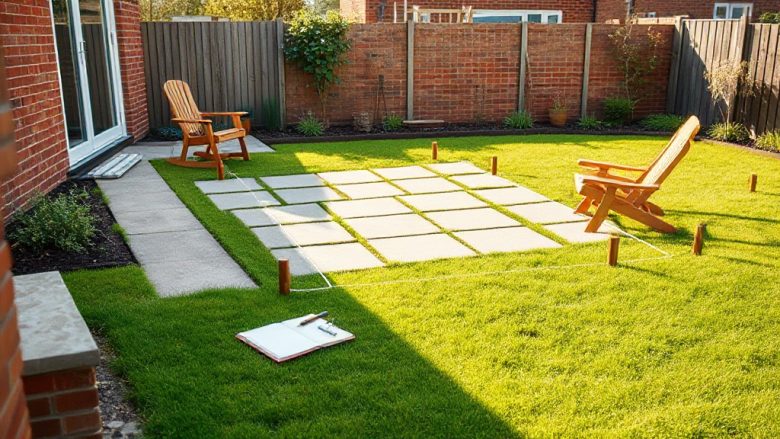
So here’s the closing move, and it’s the one that saves the most money: sketch it, mark it out, and live with it for a week. Draw the patio on paper, roughly to scale, and place your furniture on the drawing. Then go outside with string, pegs, or a garden hose and lay the outline on the ground exactly where you think it should go. Put a couple of chairs in position. Walk the route from the back door. Stand where the table would be and look back at the house. Leave it there for seven days.
A week of walking past that outline will tell you more than a month of scrolling. You’ll notice the corner that catches the wind, the spot where the sun disappears at six, the path that feels cramped. Adjust the string, not the paving. Only when the outline feels right in daily life should you order a single bag of sand or lift a single slab.
That’s how to get started with patio design without drowning in options. Three decisions, one sketch, one week of patience. The rest is just building.