The most common mistake with small outdoor spaces isn’t choosing ugly furniture. It’s buying something beautiful that leaves you nowhere to walk. A four-seat dining set can look perfectly modest in a showroom and then swallow an entire balcony, leaving a narrow gap you have to turn sideways to squeeze through. If you’re shopping for the best garden furniture for small spaces, the real constraints are floor area and storage, not style. This is a practical comparison for balconies, courtyards and tight patios, written for anyone who has to live with the furniture all year, not just on the sunny weekend they bought it.
Measure Your Usable Footprint First
Before you look at a single set, measure the space properly. Not the total balcony area, but the space you can actually place furniture in without blocking the door, the drain, the tap or the route to the washing line.
Here’s the number most people get wrong. You need roughly 60cm of clear walking space between a table and a wall, and about 75cm between a table and the edge of a step or railing. If you’re pulling chairs out to sit down, add another 45cm behind each chair. A table that’s 70cm across with two chairs on opposite sides needs close to 2 metres of length once people are seated. That’s the figure that rules out most sets on a typical 1.5m-deep balcony.
Sketch the footprint on paper, including the swing of a door and the arc of any gate. Mark where the sun lands at the time of day you’d actually use the space. A corner that’s in shade by 4pm is a corner you don’t need to furnish. The furniture that works best in small spaces is often the furniture you buy less of, placed more deliberately.
Also check what’s above and behind you. A balcony with a solid parapet blocks low-backed chairs from view, so you can push them right up against it. A glass or railing balustrade means anything you lean on is on show from the street, which changes what you’re willing to store there permanently.
Bistro Sets vs Folding Chairs vs Benches
Once you know your footprint, the choice comes down to three broad shapes, each with a different trade-off between comfort, storage and how much space they demand when in use.
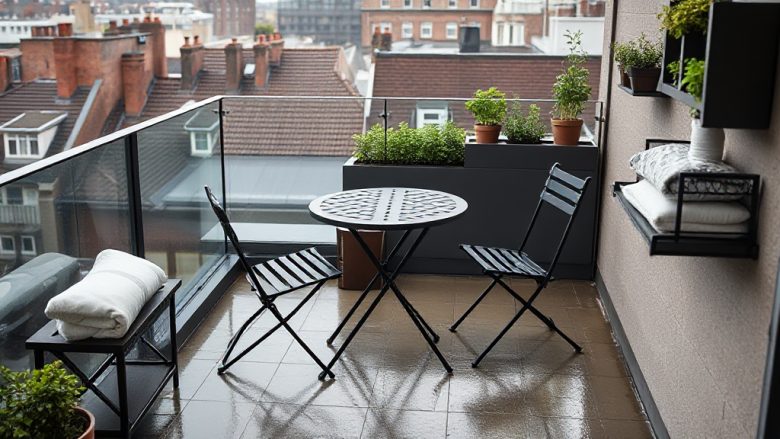
Bistro sets are the classic small-space answer: a round or square table around 60 to 70cm with two chairs. They give you a proper surface for a cup, a plate and a book, and they feel like real furniture rather than camping gear. The catch is that a bistro set is a fixed footprint. It occupies the same space whether you’re using it or not, so it only works if you have a corner that can be permanently dedicated to it. Look for a table with a folding top or a flip-up design if you want to reclaim that corner occasionally.
Folding chairs and a folding table win on flexibility. Two folding chairs and a small folding table can be stacked against a wall in under 20cm of depth and set up in thirty seconds. If your space doubles as a route to a shed or a bike store, this is usually the better answer. The trade-off is comfort: thin folding chairs are fine for an hour and unpleasant for an evening. If you go this route, spend more on the chairs than the table. A good folding chair with a shaped seat and a slight recline transforms the whole experience, and it’s the piece you’ll use most.
Benches are the underrated option. A two-seat bench with a back, around 110 to 120cm wide and 55cm deep, seats two people and takes up less floor area than two chairs with a gap between them. A backless bench can double as a low table or a plant stand when not in use. The limitation is that a bench is sociable but not flexible: you can’t rearrange it, and getting in and out of the middle of a bench against a wall is awkward. Benches suit courtyards and walled patios better than narrow balconies, where a bench across the short side can block the whole space.
There’s also the corner option worth considering: a corner bench or a corner sofa unit with storage underneath. On a square balcony, a corner unit uses the dead space where two walls meet and leaves the centre open. It’s a bigger commitment than a bistro set but often the most comfortable use of an awkward shape.
Materials That Handle UK Rain
Small-space furniture gets a harder life than garden furniture in a big garden, because it usually can’t be moved into a garage or shed. It sits out through drizzle, frost and the occasional heatwave, and it has to look decent while doing it.
Powder-coated aluminium is the safest all-round choice. It doesn’t rust, it’s light enough to move on your own, and it won’t swell, crack or need oiling. The frame will outlast most of the cushions and slings that come with it. Check the coating for chips, because once moisture gets under the powder coat on a steel fixing, rust starts. Aluminium with stainless steel fittings is the combination to look for.
Teak and other dense hardwoods handle rain well if they’re left untreated to weather to a silver-grey, or oiled once or twice a year if you want to keep the honey colour. They’re heavy, which is a plus on a windy balcony and a minus when you’re trying to store them. Cheaper softwoods marketed as garden furniture will rot at the joints within a few seasons unless you cover them.
Plastic and resin are genuinely practical, not just budget. Modern resin rattan and polypropylene chairs are UV-stable, wipe clean and don’t care about rain at all. They can look plasticky up close, but on a small balcony where the furniture is always in view, a well-shaped resin chair often looks better than a cheap wooden one that’s gone grey and mildewed.
Metal with a painted finish is the one to be cautious about. Steel frames rust from the inside out, and cast iron is far too heavy to move for cleaning or storage. If you like the look, check that the frame is aluminium underneath the paint.
Cushions are the real weak point. Anything left out through a British winter will grow mould, no matter what the label claims. Either buy furniture with quick-dry foam and a waterproof cover, or accept that cushions come inside when the weather turns. A storage box that doubles as a bench solves this neatly, but only if it’s genuinely watertight.
Storage and Stacking Options
In a small space, storage isn’t an accessory. It’s half the decision. Furniture that can’t be put away will end up permanently occupying your floor area, and that’s how a usable balcony becomes a cluttered one.
Stacking chairs are the simplest win. A stack of four takes up roughly the footprint of one and a half chairs. Check the stack height before buying, because some designs stack only two high before they become unstable. Stacking stools are even better: they work as seats, side tables and footrests, and four of them nest into a column about 40cm tall.
Folding tables and chairs that hang flat against a wall are the next step up. Wall-mounted folding tables are worth considering for balconies, where they can be dropped down when not in use and leave the floor completely clear. You’ll need to check that you’re allowed to drill into the wall, which on a leasehold balcony is not always the case.
Storage boxes and benches do double duty, holding cushions, covers and small tools while giving you somewhere to sit. Look for one with a raised base and a rubber seal, not just a lid. A box that sits directly on wet paving will draw damp up through the bottom.
Finally, think about vertical space. A small wall shelf, a hanging planter rail or a hook for a folded chair costs nothing in floor area and keeps the ground clear. On a narrow balcony, the walls are the only free real estate you have.
A Five-Point Buying Checklist
Before you commit, run through these five checks. They catch almost every expensive mistake.
One: does it fit with the chairs pulled out, not just pushed in? Measure the seated footprint, not the stored one.
Two: can you move it on your own? A piece you can’t shift will never be cleaned underneath, and dirt trapped under furniture on a small balcony is very visible.
Three: what happens to it in November? If the honest answer is “it gets ruined”, either budget for a cover or choose a different material.
Four: does it stack, fold or nest? If it does none of those things, it needs a permanent home, and you need to be sure you have one.
Five: will it still look right in three years? Trend-led shapes date quickly, and on a small balcony you see the furniture every day. A simple, well-proportioned set in a neutral finish will outlast anything fashionable.
Get those five right and the rest is preference. The best garden furniture for small spaces isn’t the smallest set you can find; it’s the one that fits your footprint, survives your weather and disappears when you need the room back. Buy for the space you actually have, and you’ll use it far more than you would a set that looked perfect in the showroom.