Most small UK gardens are asked to do too much. They need to be a drying yard, a play space, a place to eat, a view from the kitchen window and a bit of green that makes the neighbours’ fences feel less close. At the same time they’re often overlooked, north-facing, and barely wider than a parked car. The instinct is to cram in every idea saved from a screen — a fire pit, a pergola, a wildflower strip, a water feature — and the result feels busier and smaller than when you started.
Good design here isn’t about adding. It’s about subtracting, then zoning. This complete guide to small garden design in the UK walks through the process in the order you’d actually do it: measure, decide, work with the light, choose a layout, pick materials and plants, then plant and look after the result. Follow it and you’ll end up with a garden that feels calmer, larger and genuinely usable, rather than a showroom of half-finished projects.
Measure and map what you already have
Before any shopping or sketching, get the real numbers. A small garden punishes guesswork because every 30cm matters. Stand at the back door with a tape measure and a notebook, or a phone with a simple measuring app, and record the length and width at several points. Most UK plots aren’t perfect rectangles. Note where the boundaries jog, where a drain cover sits, where the manhole is, and where the soil level changes.
Then map the fixed elements. Draw a rough plan to scale on graph paper — 1 square to 50cm works well for a garden under about 8 metres long. Mark the house wall, the back door, any side return, the shed, the bin store, the outside tap, the boiler flue and the washing line anchor. These are the things you can’t easily move, and they’ll shape everything else.
Next, note the orientation. Use a compass app or simply watch where the sun falls at 9am, midday and 5pm. In the UK, a south-facing garden gets sun most of the day, a north-facing one is shaded for much of it, and east or west gardens get a strong half-day. This single fact will decide where you sit, what you grow and where you put a shed.
Finally, look at what surrounds you. Which windows overlook the garden, from your house and from next door? Where are the ugly views — a wheelie bin row, a neighbour’s extension, a telegraph pole? Where are the good ones — a mature tree, a church spire, a distant hill? You’re going to hide some and frame others, so you need to know which is which before you spend a penny.
Decide how you actually want to use the space
This is where most small gardens go wrong. People design for an imaginary lifestyle — the dinner parties, the morning yoga — rather than the real one. Be honest. Do you sit outside on a weekday evening in April, or only on summer weekends? Do you need a lawn for children or a dog, or would you rather have planted beds? Is the garden mostly a view from indoors, or a place you physically use?
Write down your top three uses and rank them. A typical small UK garden might be: somewhere to sit with a coffee, a spot for a small table to eat, and a low-maintenance green view. That’s it. A trampoline, a vegetable patch and a shed might all be wanted, but if the space is 5m by 4m, something has to give or be combined.
Think about storage too. Small gardens fail when the lawnmower, the kids’ toys and the recycling live in plain sight. If you can’t build a shed, plan a slim, tall store against a boundary wall, or use a bench with storage underneath. Decide this now, because it affects the layout.
Also decide who uses the garden and when. If you have young children, a safe, visible play area near the house matters more than a beautiful but fragile planting scheme at the far end. If you’re retired, a level, smooth path to a sunny seat might be the priority. Design for the people who’ll actually be out there, not for a magazine spread.
Work with UK light and weather
UK gardens live under a particular kind of light: often soft, often grey, and low in the sky for much of the year. That’s not a disadvantage if you design for it. The key is to know which parts of your garden are in sun, shade, or that awkward in-between, and to place things accordingly.
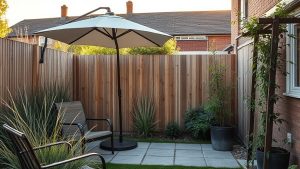
A south-facing garden is a gift, but it can also be a furnace in a hot July and a glare trap in winter. You’ll want shade — a small tree, a sail, or a pergola with climbing plants — over the seating area, and you’ll need to water more in summer. A north-facing garden is cooler and shadier, which suits ferns, hostas, and many woodland plants, but it can feel gloomy. Light-coloured paving, pale walls and reflective surfaces help lift it. East-facing gardens get morning sun and afternoon shade, good for a breakfast spot. West-facing ones get the evening sun, ideal for a table and a glass of something.
Wind is the other UK factor. Even a small garden can be a wind tunnel between fences. A permeable screen — slatted fencing, a trellis with climbers, or a hedge — slows wind without creating turbulence, unlike a solid panel. And rain: assume it will rain, often. Choose materials that don’t become slippery, and make sure the ground slopes gently away from the house so water doesn’t pool at the back door.
Don’t forget frost. In a small, enclosed garden, cold air can sit in low spots. If you’re planting tender things, keep them near a wall that holds warmth, or in pots you can move. The Royal Horticultural Society hardiness ratings are a useful guide, but your own microclimate will vary street by street.
Choose a layout that makes the garden feel bigger
Now you can start designing. The goal in a small space is to create a sense of depth and to avoid a single, flat rectangle that reads as a box. There are a few reliable tricks.
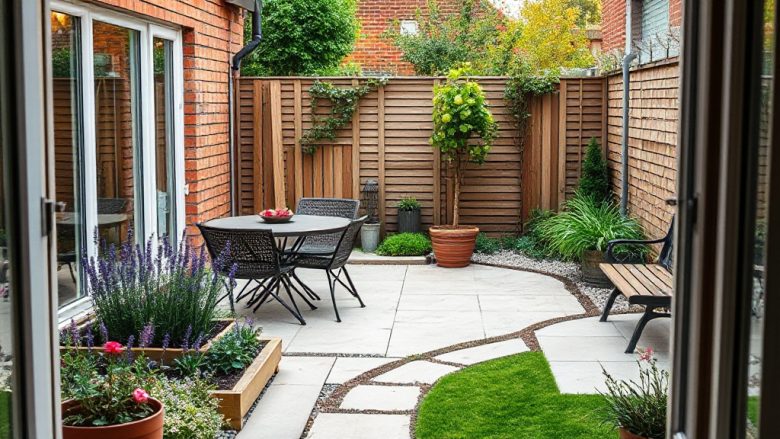
First, zone the garden. Even a 4m by 5m plot can have two or three zones: a small seating area near the house, a middle section of planting or lawn, and a focal point at the end. Zones give the eye something to move between, which makes the space feel longer. Use changes in level, different paving, or a low step to mark them.
Second, use diagonal lines. A path that runs straight down the middle emphasises the shortness of the garden. A path that curves or runs diagonally across it disguises the true dimensions. The same goes for paving patterns — lay them on the diagonal, or use a mix of sizes, to break up the rectangle.
Third, create a focal point at the far end. It could be a small tree, a sculpture, a bench, a painted shed door, or a pot. Something to draw the eye away from the house and make the garden feel like it continues. In a small space, one strong focal point is better than several weak ones.
Fourth, keep the boundary treatment consistent. A jumble of different fence styles and heights chops the garden into smaller pieces. If you can, use one material and one height, and hide the joins with planting. If you need privacy, raise the fence or add a trellis, but check planning rules first — in the UK, fences over 2m (or 1m next to a highway) usually need permission.
Finally, think about the view from inside. Most small gardens are seen through a window far more often than they’re sat in. Frame the view with planting or a structure, and make sure the first thing you see isn’t the bin.
Pick materials and plants that suit a small space
Materials matter more in a small garden because there’s less of them. A cheap-looking paving slab will be noticed; a good one will lift the whole space. In the UK, natural stone, porcelain and clay pavers all work well, but choose a light or mid-tone rather than dark, which shrinks the space. Avoid too many different materials — two or three at most, used consistently.
For boundaries, timber fencing is the default, but it can feel heavy. Slatted or hit-and-miss fencing lets light through and feels less enclosing. A low brick wall with a trellis above is another option. If you’re renting or on a budget, painting an existing fence a soft sage or charcoal can transform it for the price of a tin.
Plants are where a small garden can feel generous. The rule is simple: fewer varieties, repeated. A single repeated plant — say, a row of lavender, or a line of box balls — creates rhythm and calm. Too many different plants creates visual noise. Choose plants that earn their space: evergreen structure for winter, long-flowering perennials for summer, and a few scented things near the seating area.
For shade, think ferns, hostas, hellebores, and Japanese anemones. For sun, lavender, salvia, rudbeckia, and herbs. For a small tree, consider a weeping pear, a Japanese maple, or a crab apple — all suit containers or small borders. Climbing plants on a trellis or fence add height without taking up ground space, which is exactly what a small garden needs.
Don’t forget the soil. UK gardens vary from heavy clay to thin chalk, and small plots are often filled with builder’s rubble. Before planting, do a simple jar test to see what you’ve got, and improve it with compost. In containers, use a good peat-free multipurpose compost and feed regularly, because pots run out of nutrients fast.
Plant it, then look after it
Planting is the fun part, but it’s also where small gardens can get overcrowded. Resist the urge to fill every gap on day one. Plants grow. A border that looks sparse in spring will be full by July. Space things according to their final size, not their pot size, and be prepared to move things later.
Watering is the main job in a UK summer, especially in pots and in a sheltered garden. A simple drip irrigation kit on a timer saves hours and keeps plants alive during a hot spell. Mulching with bark or compost reduces evaporation and suppresses weeds, which matters when every centimetre is precious.
Pruning and deadheading keep a small garden looking tidy. In a tight space, an overgrown shrub can swallow a quarter of the garden in a season. Keep on top of it. Cut back climbers after flowering, and don’t let ivy or wisteria take over a fence.
Finally, accept that a small garden is never finished. It changes with the seasons and with your life. The best approach is to start with the bones — layout, boundaries, hard landscaping — get those right, and then adjust the planting over time. A garden that’s designed for how you actually live, in the light you actually have, will always feel bigger and better than one that’s simply filled with ideas.